

The Architecture of Excellence: Driving Improvement by Perfecting the Basics
By Johan Benadie, Director, Organisation Development International
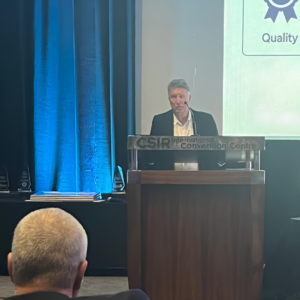
Recently shared at the Astral Foods 20 Keys Conference : ODI was delighted to be part of a day that celebrated not only achievements, but the people, ideas and commitment behind Astral’s continuous improvement journey.
Operational excellence is often associated with tools, techniques, systems and improvement projects. These are all important, but sustainable excellence goes much deeper. It is created when our processes, standards, structures, capabilities, and behaviours work together, supported by leadership that understands why improvement matters in the first place.
At its heart, operational excellence is about getting the fundamentals right – and then continuously making them better.
Start with a compelling “why”
People need to understand why improvement matters.
If the purpose is not clear, continuous improvement can very easily become another programme, another checklist, or something we do because management expects it.
A compelling “why” creates psychological commitment. It helps people connect their daily work to something bigger and gives meaning to the effort required to change.
Strong leadership starts here. When people understand the purpose, improvement becomes something they participate in rather than something that is done to them.
Kaizen – better every day
Kaizen is not complicated.
It is the discipline of continually looking at what we do and asking how we can make it better.
The improvements do not always need to be big. In fact, operational excellence is more often created through the accumulation of many small improvements carried out consistently over time.
- A small reduction in waste.
- A slightly faster changeover.
- A more reliable machine.
- A better way of sharing information.
- An improvement in hatchability, feed conversion or product recovery.
Individually, these may appear small. Collectively, they can fundamentally change the performance of a business.
What can we make a little better today?
Kaizen is therefore not an event. It is a way of thinking and working. It sits within a people-centric approach where people’s well-being, needs and growth are at the core of strategy and culture.

Absolute respect for people, machines and products
One of the principles I believe in strongly is absolute respect for people, machines, and products.
Walk into any workplace and you can very quickly see what an organisation truly values.
- How are people spoken to and treated?
- What condition is the equipment in?
- How is the product handled?
- Are abnormalities ignored or addressed?
Operational excellence should be visible in the everyday condition of the workplace – not only in presentations, reports and performance measures.
Respect is demonstrated through behaviour.
Leadership must be respectful, visible and energising
Leaders cannot understand a workplace only from reports and dashboards.
We need to be visible where the work happens.
That means going to the floor, observing, asking questions, listening and understanding what people experience every day.
But visibility by itself is not enough.
Our leadership style must be appropriate to the people and the situation. How we enter a workplace, how we react to a problem, and how we engage with people all send a message.
When you walk through the workplace, what message do your movements leave behind?
Do people feel more confident after you have been there? Have you helped them think? Have you encouraged ownership? Have you left the workplace energised?
Or have people simply learned to keep their heads down until management leaves?
Respectful, visible and energising leadership builds capability. It creates an environment in which people want to participate in improvement rather than merely comply with instructions.
Improve the system, not only the number
Measures and targets matter, but we must be careful not to spend all our energy chasing the result.
The result is an output of a system.
Performance comes from the interaction between people, processes, systems, and technology.
If we want better outputs, we need to understand and improve the inputs that produce them.
This is why standards are so important.
Good standards provide the stable baseline from which we can identify abnormalities, solve problems, and improve. Without standards, we cannot easily distinguish between normal variation and a genuine problem.
But standardisation should never mean that we stop questioning.
The standard represents the best-known way today. Kaizen asks us to find a better way tomorrow.
The challenge is to maintain the balance between discipline and improvement – following the standards that protect quality, safety, and consistency while continuously challenging ourselves to improve them.
Deep implementation matters
One of the greatest risks in continuous improvement is surface-level implementation.
We can introduce boards, checklists, schedules, 5S activities, meetings, and improvement projects and still fail to address the real constraint.
This is why I place so much emphasis on understanding the principle behind the tool.
Principles → Understanding → Application → Execution
Without understanding, organisations can become very busy doing improvement activities without necessarily improving the system.
A good example is the story I used in my presentation of Bradley and “The Fixers”.
A maintenance team can introduce preventive-maintenance schedules, gather more data, develop critical-spares lists and apply 5S to machines, workshops and engineering stores. These are all worthwhile activities.
But if the underlying constraint is not addressed, the impact will remain limited and may not be sustainable.
Modern maintenance has already moved well beyond a purely reactive, historical break-fix model. The opportunity now lies in cost-effective, data-driven, predictive, and prescriptive approaches that improve long-term asset reliability and extend equipment life.
What might once have been a strength can become the constraint.
Experience is valuable. Established systems are valuable. But when yesterday’s successful way of working prevents us from adapting to today’s environment, it can begin to hold the organisation back.
We need thinking people
Operational excellence should not create organisations full of people waiting to be told what to do.
We need thinking people.
- People who can recognise waste.
- People who understand their equipment.
- People who notice abnormalities.
- People who ask why.
- People who solve problems and improve the standards of their own work.
That requires continuous learning and knowledge development.
It also means creating organisations in which information flows effectively – vertically through the organisation and horizontally across functions.
Too much organisational waste is created because information remains trapped in departments, spreadsheets or disconnected systems. The same information gets requested repeatedly, captured several times or recreated because people cannot easily access what already exists.
That is not simply an information problem. It is operational waste.
Technology must enable Kaizen, not digitise waste
Technology and AI create enormous opportunities for continuous improvement.
They allow us to process information faster, identify patterns, generate ideas, and respond more quickly than ever before.
But technology does not remove the need for good operational principles.
If we automate a poor process, we simply create a faster poor process.
Before digitising something, we should therefore ask whether the process itself makes sense.
Technology should help us remove waste, improve visibility, strengthen decision-making and enable people to improve more quickly.
This is where I believe Kaizen becomes even more powerful in the digital age. If technology allows us to implement and learn from small improvements more rapidly, the cumulative effect can be enormous.
It still comes back to people
After all the discussion about systems, processes, equipment, information, technology, and AI, operational excellence still comes back to people.
- People need skills and opportunities to learn.
- They need to be safe and respected.
- They need to understand what good performance looks like.
- They need the authority and confidence to improve their own work.
- They need to understand the customer and the value they create.
- And they need leaders who build capability rather than dependency.
The architecture can ultimately be expressed quite simply:
Great people → Great processes → Great results
That does not mean the journey is easy.
Excellence requires discipline. It requires leadership. It requires standards. And it requires the willingness to continue improving even when things are already going well.
Strategy can be written on paper.
Operational excellence is demonstrated in the daily discipline of doing the right things right – even when nobody is watching.
There is seldom one spectacular action that creates excellence.
More often, it is the accumulation of many small things, consistently done to a very high standard.
That is Kaizen.
And that is how we build the architecture of excellence.
To read more about The 2026 Astral Foods’ 20 Keys Conference, click here.