
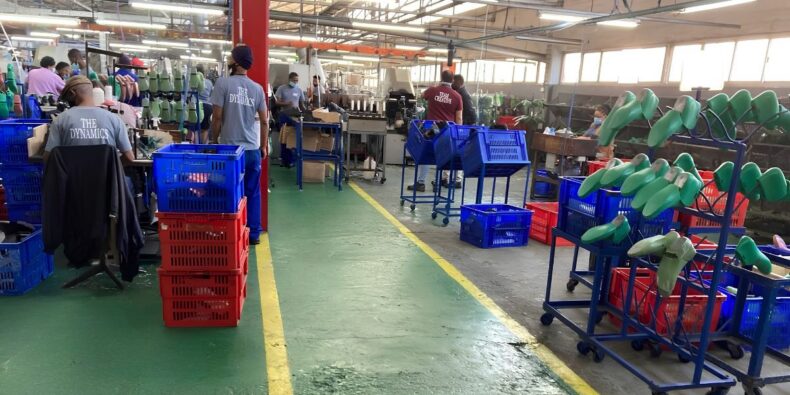
BBF’s Venothan Munsami wrote about his Opex journey as follows:

“My Opex journey at BBF was one of trepidation and anxiety, as firstly it had been years since I had finished school, and now I was studying, running around, and writing tests and assignments. I was difficult in class, challenged the status quo as we went along, and asked many questions when the need arose. In training, I thought that when we came to the end of something, you couldn’t do anything, and that was acceptable.
When I started this course, my project was in the making department, and we went through the paces at first with those who were used to doing things their way and wouldn’t change, but the new generation bought into change. They were always included in the journey, which made implementation easier and helped us move forward. The push to do well in the course, asking a million questions, and getting your own support allowed me, with the team, to move forward; not to mention Brett giving us the freedom to explore and make changes, which also helped. I still remember my plan and the industry people who said it wouldn’t work, which pushed me to prove it would. Then came COVID, and this afforded us the perfect time to make the changes.
Making went from working 2 shifts in a day with more than 80 odd people and producing 600 pairs per cell per shift. A total of 6 cells. We are now down to 43 staff, working a single shift and producing 900 pairs per cell (4 cells). Our footprint in making decreased by 2/3. We used to have stacks of boxes in every process, clutter, no flow and huge WIP +- 10 000 plus pairs, stack of racks with lasts to do WIP. This has all disappeared almost entirely only for the start of the process (Boxes), lasts we use 10 pairs per size per cell and this turns around keeping the one piece flow. Staff are multi-skilled and relieve each other when it comes to toilet breaks, so the cell doesn’t stop.
WIP planned for the day is out for the day, reducing lead time to 1 day from 3 days. WIP is averaging around 3000 pairs per day when we start up, meaning we are 1500 pairs ahead of the next day’s production.
Quality, scraps, and Rejects have all fallen below 0.50% daily. Morale, team meetings, etc., are practiced daily; there are still many changes taking place in this department, improving every day.
Doing OPEX was the best thing for me; it gave me a chance to coach, share knowledge, do root cause analyses, and see employees’ lives improve tremendously. Due to natural attrition people finished off work and we never replaced.
Making Department Transformation
BBF’s Salman Jonas, Quality Officer, writes:
“The Making Department has achieved remarkable improvements, representing a significant transformation from its historical state.
The department has made substantial progress in establishing a more structured and efficient production flow, with improved processes, better coordination, and greater focus on operational efficiency. These improvements have contributed to a more stable and effective manufacturing environment.
Quality awareness has also increased noticeably across the department. Teams are more proactive in identifying potential quality issues, and earlier detection of non-conformities allows quicker intervention and corrective action. This has reduced the risk of issues progressing further through the production process and strengthened overall quality ownership.
The improvements are not limited to individual processes; the department has also seen broader positive change, with greater discipline, accountability, and awareness of performance requirements.
Overall, the Making Department is in a significantly stronger position than it was historically. The transformation achieved to date demonstrates clear progress in production flow, efficiency, quality awareness, and early identification of non-conformities. While there is still room for improvement, the department has come a long way and built a much stronger foundation for sustainable performance.

Doing a full learnership is always a good idea, as there are so many benefits attached to it, HOWEVER, there certainly are times when a shorter intervention is required, to obtain some quicker gains for the organisation.
The Skills Programmes offered by ODI have been carefully selected to offer such interventions, to ensure maximum benefits. This selection of Skills Programmes is based on many years of experience, gained in the environment of Operations Excellence, and has proven to energise the workplace, and to set the foundation for quicker gains.
Although this is a carefully selected list of Skills Programmes, the ODI offering is not limited to these ones only. Where requested, ODI has clustered certain Unit Standards to specific customer needs.
To find out more about ODI’s Skills Programmes, please click here.