
A real-world case study applying the CAPDo cycle from 20 Keys Key 3: Small Group Activities
By George Meiring | Productivity Consulting | Gqeberha, South Africa
| I once paid a plumber to move a geyser. The problem didn’t go away. I had jumped straight to a solution without understanding the problem. Sound familiar? This is the story of how a structured problem-solving approach and an honest conversation with AI eventually found the real answer. |
The Situation
My home in Gqeberha has two 150-litre Kwikhot solar/electric geysers on the roof. Both solar collectors sit adjacent to each other on the Eastern slope, so they receive identical sunlight. Each geyser has a small 12V PV-powered circulation pump. The geysers are roughly 15 meters apart:
Geyser No. 1 is on the North-West side of the roof;
Geyser No. 2 is on the South-East side, directly below its solar panel with a short vertical pipe connection.
Every morning without fail, Geyser No. 1 is 10°C hotter than No. 2, despite both being fed by identical, adjacent solar panels. Something was systematically draining the heat from Geyser No. 2 overnight.
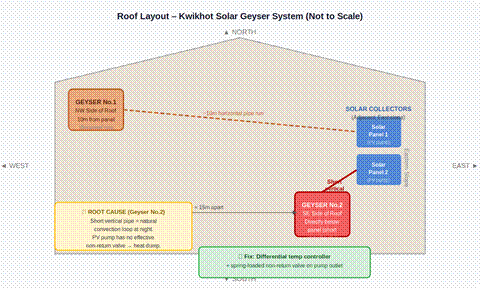
Figure 1 — Roof layout: geyser positions, pipe geometry, root cause and proposed fix
Lesson 1: Don’t Jump to Solutions
My first instinct? Geyser No. 2 was mounted on the outside wall, exposed to the cold overnight air. Obvious cause. Obvious fix. I even ran it past Grok AI, which agreed: if external cold exposure was the root cause, moving the geyser inside was a no-brainer. R5 000 and a plumber later, the geyser was inside the roof cavity.
| ❌ The 10°C morning differential persisted. Unchanged. I had skipped straight from symptom observation to solution implementation, bypassing problem definition, information gathering, and root cause analysis entirely. I had made an assumption, got AI to confirm it felt logical, and acted on it as if it were a verified fact. R5 000 and the problem remained. This is precisely what the CAPDo cycle is designed to prevent. |
The CAPDo Cycle: Key 3: Small Group Activities

In the 20 Keys to Workplace Improvement framework, Key 3 (Small Group Activities) uses the CAPDo cycle as the backbone of structured problem solving. It looks deceptively simple. The discipline is in following the steps in sequence, especially not skipping to Plan and Do before you have truly Checked and Analysed.
Figure 2 — The CAPDo Cycle: Check → Analyse → Plan → Do → Celebrate Success
| CHECK | ANALYSE | PLAN | Do |
| Define the problem clearly. Verify you are solving the right problem before doing anything else. | Collect information. Understand the system. Do Root Cause Analysis — Fishbone, 5 Whys. Verify the root cause is real. | Generate solutions. Prioritise. Select the best countermeasure. Cost it. Plan implementation. | Implement the plan. Follow up. Verify it works. Celebrate success — and share the learning. |
Lesson 2: Use AI Wisely; It’s a Diagnostic Partner, Not a Decision-Maker
Months after the failed relocation, I put the problem to Google AI Mode in a structured conversation, progressively sharing the layout details. Watch how the diagnosis only became possible once I provided the critical geometry:
| George | We have two 150l Kwikhot solar/electric geysers on our roof. Geyser No.1 is on the North-West side and No.2 on the South-Eastern side — approximately 15m apart. No.1 is typically 10°C hotter in mornings than No.2. Both solar panels are adjacent to each other on the Eastern slope. |
| AI | Geyser No.1 is hotter because Geyser No.2 is experiencing major thermal line losses due to the 15m pipe run, or a faulty electrical backup system. Because both panels receive identical solar radiation, the 10°C morning deficit in No.2 points directly to heat escaping during the transfer process or a failure to maintain heat overnight. |
— George provides the missing geometry —
| George | Geyser No.2 is closer than No.1 to the solar panels. It is directly below them, while No.1 is about 10m away from its solar panel. |
| AI | Geyser No.2 is colder because it is experiencing nighttime reverse-thermosiphoning, where its short, vertical pipe run creates a natural convection loop that dumps tank heat out through the solar panels overnight. Geyser No.1 avoids this because its 10m horizontal pipe run creates too much fluid friction for the weak reverse flow to occur. |
| George | The solar panels are fitted with a PV-powered pump (small solar panel and motor each) to circulate the water during the day. Could this have an effect? No.2 was originally placed outside the roof, on the wall — we thought the temperature drop was due to it being outside. We had it relocated inside. Differential persists. |
| AI | Yes — the small PV-powered pump is the exact reason Geyser No.2 is losing heat overnight, and why moving it inside the roof cavity did not fix the issue. In the late afternoon, the East-facing collectors go into shade early — but the small PV pump panel may still receive enough ambient light to keep running. It actively circulates water from the hot geyser through panels that are now rapidly cooling. It acts as a radiator, stripping heat from Geyser No.2 right before sunset. Once the pump stops, the short vertical pipe allows passive reverse-thermosiphoning all night long. |
| 💡 What the AI exchange illustrates: The AI gave a plausible but wrong first answer, because it didn’t yet have the full picture. Only when the geometry was shared (No.2 directly below the panels, short vertical pipe) did the correct diagnosis emerge. The quality of the AI’s answer was directly proportional to the quality of the information provided. This is exactly how a good diagnostic conversation works with a colleague, a consultant, or an AI. |
What AI Can and Can’t Do
AI is a powerful diagnostic partner, but it is not a replacement for physical verification. Before spending a cent on any solution, the human still has to go and check:
| AI is good at… • Pattern-matching across thousands of technical cases instantly • Asking the right diagnostic questions when you describe symptoms • Explaining the physics or theory behind a root cause • Quantifying cost of the problem to justify the fix • Generating a range of possible solutions to compare | You still need to… • Physically inspecting what is actually installed • Verifying whether the proposed root cause is true in your specific case • Confirming a non-return valve or thermal switch is not already present • Observing whether the pump actually runs after sunset • Making the final call — and being accountable for the decision |
| ⚠ The root cause still requires your physical verification before you implement Q1: Is reverse-thermosiphoning theoretically the root cause? YES, confirmed by AI and technical sources. Q2: Is it actually happening in your installation? CHECK: Is a non-return valve already fitted? Is a differential temperature switch already wired? Is the pump actually running after sunset? Do not repeat the earlier mistake. Verify before you spend. |
Applying CAPDo to This Case, All 8 Steps
Here is how the full CAPDo cycle maps to this geyser problem, including the cost justification that made Step 5 a clear, confident decision:
| Step | Phase | CAPDo Action | This Case Study |
| 1 | CHECK | Define the problem | 10°C morning temperature gap — Geyser No.2 consistently colder than No.1, despite identical solar input from adjacent panels. |
| 2 | CHECK | Collect information & verify the problem statement | Gap confirmed as consistent and daily. Key geometry mapped: No.2 directly below its panel (short vertical pipe); No.1 is 10m away (horizontal run). Both have 12V PV-driven pumps. Previous fix (moving geyser inside) confirmed ineffective. |
| 3 | ANALYSE | Root Cause Analysis — Fishbone / 5 Whys | 5 Whys: Cold mornings → loses heat overnight → pump circulates water through cooling panels at dusk → no differential temperature control → short vertical pipe enables reverse-thermosiphoning at night. Proposed RC: uncontrolled PV pump + reverse-thermosiphon. |
| 3b | ANALYSE | Verify the root cause (Q1 & Q2) | Q1 — Is it theoretically valid? YES — reverse-thermosiphoning is a well-documented phenomenon in short vertical solar pipe configurations. Q2 — Is it true in THIS installation? PENDING — physically check: Is a non-return valve already fitted? Is a differential temp switch already wired? Is the pump actually running after sunset? |
| 4 | PLAN | Generate possible solutions | A) Differential temperature controller (stop pump when panel < tank). B) Spring-loaded non-return valve on pump outlet. C) Pipe insulation. D) Relocate geyser — ALREADY TRIED, ineffective. |
| 5 | PLAN | Prioritise & select best countermeasure | A + B selected (differential temperature controller + spring-loaded NRV). Note: the R5 000 already spent on relocating the geyser inside the roof was the earlier wrong solution — validated at the time by Grok AI on the assumption that external cold was the root cause. That assumption was never physically verified. Cost of jumping to an unverified solution: R5 000. |
| 6 | PLAN | Plan implementation | Procure 12V differential controller + brass spring-loaded NRV. Schedule plumber and electrician. Define success criterion: gap < 2°C within 7 days of installation. |
| 7 | Do | Implement | Install differential temperature controller wired between PV panel and pump. Plumber fits spring-loaded NRV on pump discharge line. |
| 8 | Do | Follow up — verify & celebrate | Monitor morning temperatures for 7 days. Confirm gap < 2°C. Document the result. Share the learning. Celebrate success. |
Key Takeaways
| ✨ Two lessons, one case study 1. Don’t jump to solutions. Follow the CAPDo cycle in sequence. Never move to Plan and Do before you have fully Checked and Analysed, including verifying that your proposed root cause is actually true in your specific situation. 2. Use AI wisely. AI is a brilliant diagnostic partner that can reason across thousands of cases in seconds. But it works with what you give it. Provide good information, ask good questions, and treat its answers as hypotheses to verify — not conclusions to act on. The combination of structured thinking and AI assistance is powerful. Neither alone is sufficient. |
Have you ever jumped to a solution that didn’t work?
Share your story in the comments, or tag someone who needs to read this. The CAPDo cycle is not just for engineers; it works wherever problems need solving. If you’d like to know more about the 20 Keys to Workplace Improvement framework and how it applies in your workplace, reach out directly.
Click here to read more about applying the CAPDo cycle for operations improvement.